
History of Marble Inlay Art in Agra
Explore the rich history of marble inlay art in Agra, showcasing the intricate techniques and cultural significance behind this timeless craft. Discover how Agra became a hub for exquisite marble artistry.
Cultural Heritage · Agra, India
The Art of Parchin Kari
Marble Inlay of the Mughals
A living tradition from the 16th century to the present day
Lapis Lazuli Malachite Cornelian Turquoise Shell
Origins: A Persian Art Meets Indian Marble
Originally practices in Florence, Italy during The Renaissance, the ancient art of marble inlay in Agra traces its roots to the Mughal era, reaching its pinnacle during the 16th and 17th centuries. Known locally as Parchin Kari (also spelled Pacchekari), this exquisite craft emerged from the confluence of Persian artistic tradition and Indian artisanship, brought to the Indian subcontinent by master craftsmen who accompanied the Mughal emperors.
The art form took early root during the reign of Emperor Akbar in the late 16th century, as the Mughals sought ways to embellish their grand architectural projects with works of lasting beauty. The technique quickly became a defining feature of Mughal aesthetics — a visual language of grandeur expressed in stone and gemstone alike.
"Parchin Kari found its most celebrated expression in the Taj Mahal — where marble inlay work showcases the extraordinary skill of ancient craftsmen for all time."
Agra emerged as the natural epicenter of this tradition. The city's proximity to the world-renowned Makrana marble quarries of Rajasthan — whose white marble is prized for its translucency and durability — created ideal conditions for the craft to flourish under royal patronage. Over centuries, specific neighborhoods in Agra became synonymous with this artistry, with families dedicating generations to perfecting their techniques.
The regional influence of Parchin Kari eventually spread beyond Agra to Delhi and Jaipur, where each city developed subtle stylistic variations. Yet Agra has remained, and continues to be, the undisputed center of excellence for authentic marble inlay work.
The Craft: Techniques, Tools, & Materials
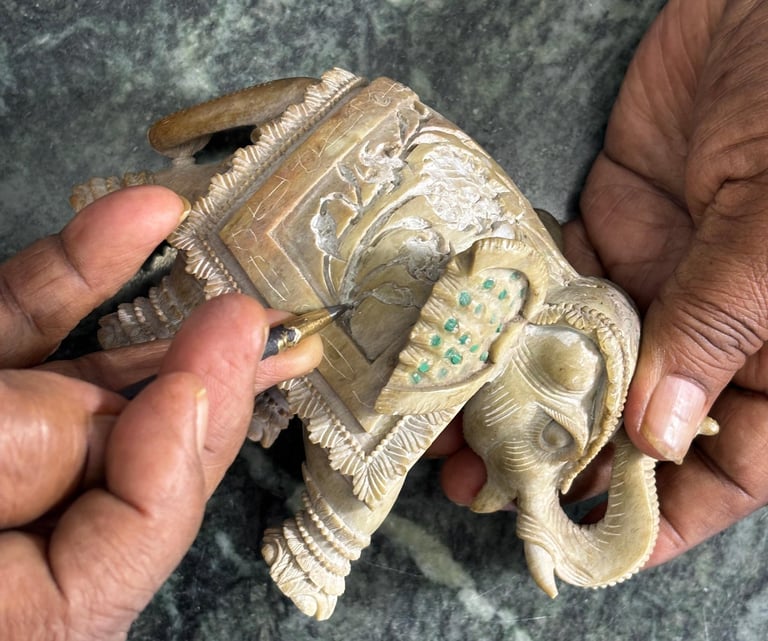
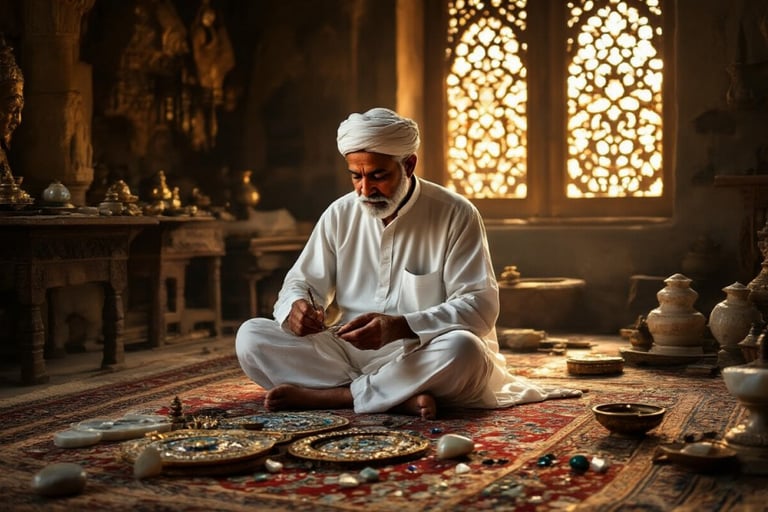
Parchin Kari is an elaborate and painstaking process. Artisans begin by meticulously carving intricate patterns — floral motifs, geometric designs, and calligraphic elements drawn from Mughal aesthetic tradition — directly into the surface of white Makrana marble. Into these carved recesses, precisely shaped pieces of natural gemstones are inlaid with extraordinary precision, creating seamless compositions that seem to bloom from within the stone itself.
The gemstones are selected not only for their beauty, but for their color consistency, hardness, and luminosity — qualities that determine how a piece will look and endure across centuries.
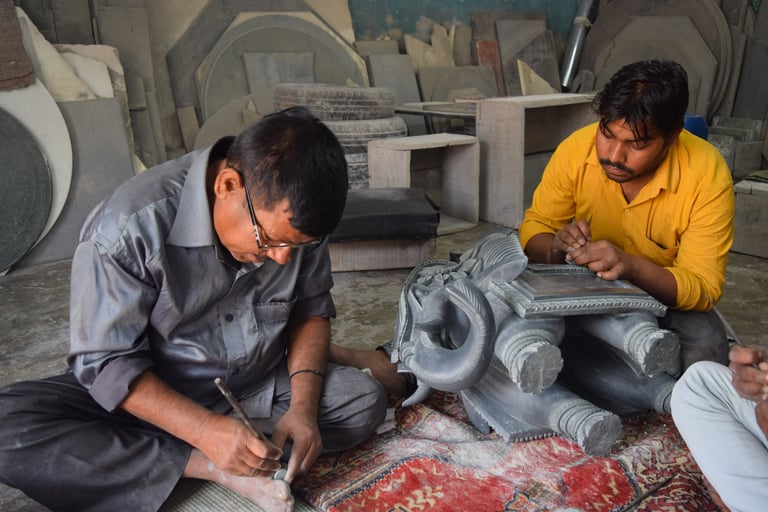
The tooling of authentic Parchin Kari is entirely hand-driven. Artisans use chisels, hand-driven grinding wheels, and specially designed engraving tools to cut both the marble and the inlay stones. This hand-tool process is what distinguishes genuine pieces from machine-produced imitations — the slight irregularities of the human hand create depth and warmth that no machine can replicate.
What makes authentic Parchin Kari identifiable: In genuine inlay, the stone pieces fit their recesses with no visible adhesive gap — a perfect interlocking achieved through hand-shaping. The polish of the inlaid surface is flush with the surrounding marble, creating a smooth, unbroken plane. Under raking light, authentic work reveals the subtle texture of hand-polishing rather than the mechanical uniformity of machine work.
03
The Master Craftsmen: Ustads & Generational Knowledge
The soul of Parchin Kari lives not in the marble or the gemstones, but in the hands and minds of its practitioners. Master craftsmen, known as ustads, have traditionally passed their skills through family lineages across generations, creating distinct artistic signatures and stylistic vocabularies that remain identifiable across centuries.
Traditional training in authentic marble inlay is a lifelong pursuit — beginning with foundational stone cutting in youth and advancing through progressively complex inlay work over decades. Masters develop an intimate knowledge of stone: how different materials interact, how they age, which combinations maintain structural integrity over generations, and which color pairings sing most beautifully against white marble.
04
Legacy Today: Art, Economy, & Preservation
Today, marble inlay continues to thrive in Agra, drawing visitors and collectors from across the world. The craft is simultaneously a pillar of Agra's tourism economy and a living cultural heritage — one that the city takes active pride in preserving and promoting.
Several workshops and galleries in Agra continue operating under the stewardship of families who are direct descendants of the earliest Mughal-era craftsmen. Among the oldest and most celebrated of these is Subhash Emporium, where a museum section houses a legacy collection of marble inlay works of the kind that the world's finest museums would be proud to display. Workshops like these offer visitors the rare opportunity to witness Parchin Kari being practiced in real time — from stone selection and carving to the final inlaid piece.
The cultural significance of Parchin Kari has grown beyond its decorative function. Authentic pieces are increasingly recognized as investment-grade collectibles — irreplaceable works that embody both artistic mastery and historical continuity. Museums and private collectors worldwide actively seek authenticated pieces, creating sustained demand for properly documented works created by master craftsmen.
"An art once practiced to decorate royal architecture now blooms in brilliant modern forms — carrying four centuries of skill into every home that welcomes it."
Perhaps most importantly, Parchin Kari stands as a quiet act of resistance against the homogenization of decorative arts. In an era of mass production, a hand-inlaid marble piece offers something that no factory can manufacture: a tactile and visual connection to human creativity, cultural memory, and the extraordinary patience of those who have dedicated their lives to this tradition.
Educating visitors and collectors about the history, techniques, and markers of authenticity is not merely academic — it is the most practical form of preservation. An informed audience creates demand for genuine craft; genuine demand keeps the ustads and their workshops alive; living workshops ensure the knowledge passes to another generation.
The marble inlay tradition of Agra is recognized as an intangible cultural heritage of India. Visitors to Agra are encouraged to visit authentic workshops, observe the craft firsthand, and purchase directly from master craftsmen or established galleries to support the continuation of this art.
© Subhash Emporium 2026
All trademarks used are the property of their respective owners.
inlayartisan@gmail.com