
How to check the authenticity of your Parchin Kari (marble inlay) art piece.
Discover how to identify authentic handcrafted Parchin Kari (marble inlay) art and distinguish it from machine-made imitations. From examining the precision of the inlay work and the quality of semi-precious stones to understanding the characteristics of genuine marble, this guide helps art lovers and collectors appreciate the true craftsmanship behind this centuries-old art form inspired by the exquisite beauty of the Taj Mahal. Learn the essential visual checks that reveal the authenticity, heritage, and artistry of genuine marble inlay work.
Essential Visual Inspection Techniques to Authenticate Semi-Precious Stones in Parchin Kari
Examining Stone Setting Precision and Alignment
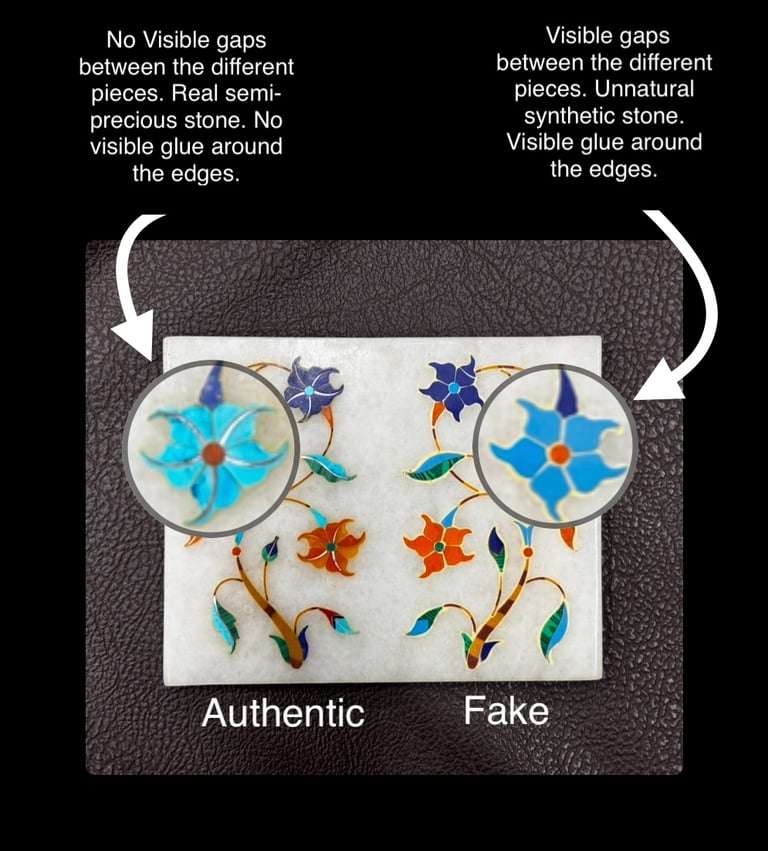
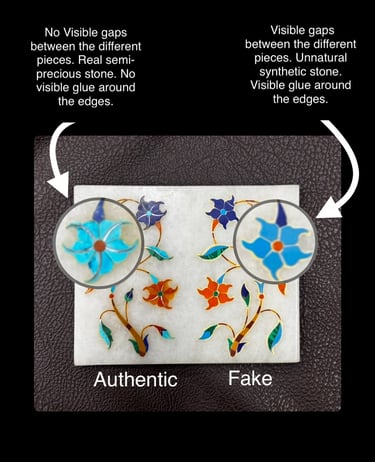
Authentic Parchin Kari reveals itself through the microscopic precision of stone placement. Master craftsmen achieve near-perfect alignment where individual stones fit together like pieces of an intricate puzzle. There shouldn't be any gaps between the inlaid stones in genuine marble inlay work, creating seamless visual flow. Mass produced & machine-made replicas typically show wider, irregular gaps or artificially uniform spacing that lacks the subtle variations of human craftsmanship.
The stone setting in traditional Parchin Kari demonstrates extraordinary attention to geometric patterns. Each stone receives careful positioning to maintain the overall design integrity, with slight adjustments made to accommodate natural variations in stone size. Authentic pieces show stones that align perfectly with the underlying pattern, while mass produced & machine-made versions often display stones that appear forced into predetermined spaces.
Examining the depth consistency of stone setting provides another authentication marker. Hand-set stones in authentic Parchin Kari maintain uniform depth levels, with each piece sitting flush with the marble surface. The setting adhesive remains invisible in genuine pieces, whereas mass produced & machine-made replicas may show excess adhesive or uneven depths where automated processes failed to account for natural stone variations.
1.) Identifying Hand-Shaped vs Machine-Cut Stone Edges
Hand-carved stone edges in authentic marble inlay art display characteristic micro-variations that distinguish them from machine-precision cuts. Traditional craftsmen use specialized tools to shape each stone individually, creating subtle irregularities along the edges that contribute to the piece's authentic character. There have only been a few master craftsmen or 'ustads' of the modern generation who achieved a machine level precision with their hands. Amongst them include, late Ustad Mohammed Zafar Hussain & Ustad Mohammed Shameem whose works exhibited in the museum of Subhash Emporium are considered the finest pieces every created in this artform.
Machine-cut stones exhibit perfectly uniform edges with smooth surfaces. While this precision might appear superior, it lacks the organic quality that defines handmade marble inlay. These edges are achieved because of using machine grinders for shaping the stones.
2.) Recognizing Natural Color Variations in Authentic Stones
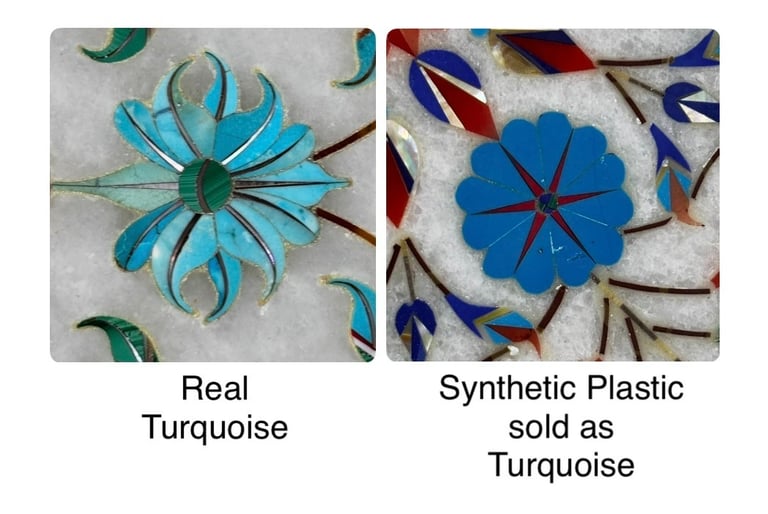
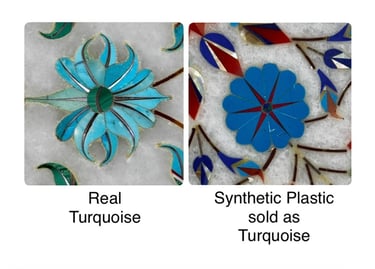
Natural precious and semi-precious stones used in genuine Parchin Kari exhibit subtle color gradations and mineral inclusions that mass produced & machine-made replicas cannot replicate convincingly. Authentic pieces incorporate stones with natural color variations within individual pieces, creating depth and visual interest. These variations appear random and organic, following the natural formation patterns of the source minerals.
Dyed or synthetic stones in mass produced & machine-made replicas display uniform coloration throughout each piece. The colors often appear artificially vibrant and lack the subtle tonal shifts found in natural materials. Authentic Parchin Kari uses stones where color intensity varies slightly across the surface, creating natural highlights and shadows.
A very easy way to identify fake or synthetic stones in marble inlay art is by poking them with a needle. If the stone gets pierced easily or with slightest of pressure, then the stone is fake or synthetic. The needle will always tend to slip on a real hard semi-precious stone indicating its authenticity.
The aging characteristics of natural stones provide additional authentication clues. Genuine stones develop patina over time, with colors becoming more mellow and integrated. Mass produced & machine-made pieces using synthetic materials maintain their original brightness and fail to develop the characteristic aging patterns seen in authentic marble inlay craftsmanship quality.
3.) Spotting Inconsistencies That Indicate Human Craftsmanship
Paradoxically, slight imperfections serve as markers of authenticity in handmade Parchin Kari identification. Master craftsmen working by hand produce variations in line thickness, pattern symmetry, and stone placement that reflect the human element in creation. These inconsistencies, typically measuring less than 1 millimeter by a master craftsmen and 3-5 millimeter by an apprentice artist, add character and confirm hand-crafted origins.
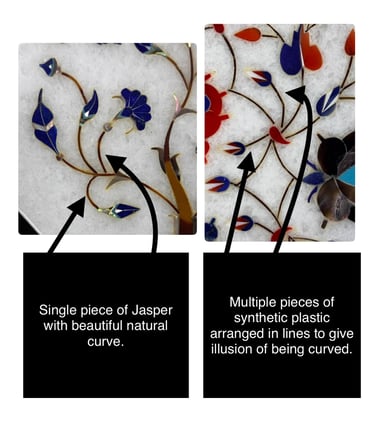
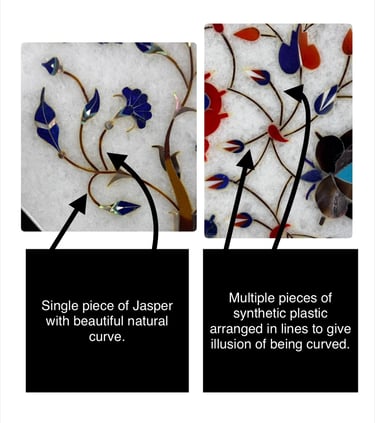
Pattern flow in authentic pieces shows organic transitions where designs adapt to the natural constraints of working with individual stones. Even after being separate pieces of different sizes, an authentic workshop shapes these pieces in a beautifully flowing (natural) curving shapes. Mass produced & machine-made replicas maintain rigid pattern adherence with pieces that are straight rather than being curved without the subtle adjustments that craftsmen make to enhance overall visual harmony. These human decisions create unique characteristics that distinguish each authentic piece. A rose design is the most common motif in poorly crafted or mass produced pieces.
The surface texture of genuine Parchin Kari displays minute variations in polish levels and stone heights. Hand-polishing creates slight undulations that affect light reflection across the surface. Mass produced & machine-made versions typically show perfectly uniform surface levels that lack this dynamic quality, resulting in static light reflection patterns that appear artificial compared to authentic marble inlay art.
Parchin Kari, also known as Pietra Dura or marble inlay art, is one of the finest handcrafted art forms originating from Agra — the same exquisite technique used in the decoration of the iconic Taj Mahal. With the growing popularity of marble inlay souvenirs and décor pieces, the market today is flooded with machine-made imitations and low-quality replicas. Knowing how to visually identify authentic handcrafted Parchin Kari can help you appreciate the true craftsmanship behind the artwork and make an informed purchase.
Physical Testing Methods to Verify Authenticity Of Makrana Marble
(As used in the Taj Mahal & in traditional Parchin Kari art)
1.) Assessing Weight Distribution and Marble Density
Genuine Parchin Kari pieces made from authentic marble display distinct weight characteristics that differ significantly from mass produced & machine-made replicas. Real marble inlay art carries substantial heft due to the natural density of premium Makrana marble, typically ranging from 2.6 to 2.8 grams per cubic centimeter. When handling an authentic piece, the weight feels evenly distributed throughout the structure, reflecting the uniform density of quality stone.
Mass produced & machine-made replicas often use composite materials, synthetic resins, or low-grade marble substitutes like the Italian, Vietnamese or Australian marble that feel noticeably lighter. Other alternatives include cheap soapstone which is used by small souvenir shops. These materials lack the characteristic density of authentic marble inlay, creating an immediate red flag during physical examination. The weight distribution in replicas tends to feel uneven, with certain areas feeling hollow or artificially dense due to filler materials.
Experienced collectors and artisans at established workshops like Subhash Emporium, the oldest gallery in Agra for Parchinkari, emphasize the importance of using authentic Makrana Marble same as used in the Taj Mahal. Authentic pieces from genuine marble inlay workshops in Agra maintain consistent density patterns that reflect centuries of traditional craftsmanship techniques.
To perform this assessment effectively, compare the suspected piece with known authentic samples of similar size. The weight difference between genuine and replica pieces often becomes apparent immediately, providing a reliable initial screening method for authentication.
2.) Checking Surface Texture and Marble Porosity
The surface characteristics of authentic Parchin Kari marble reveal crucial information about the stone's origin and processing methods. Natural Makrana marble is distinguished by its non-porous nature, meaning it does not absorb liquids spilled on its surface, and by its natural translucency, which allows light to pass through due to the presence of tightly packed calcite crystals. Additionally, its exceptional strength, non-yellowing quality, high durability, and extremely fine grain structure make Makrana marble the most suitable and enduring material for marble inlay art, a choice that continues to be upheld by authentic workshops such as Subhash Emporium.
Authentic pieces display a lustrous finish with microscopic variations that reflect light naturally, creating depth and warmth in the appearance.
Mass produced & machine-made replicas typically feature artificially uniform surfaces created through industrial polishing processes. These surfaces feel overly smooth and lack the subtle textural variations found in authentic marble inlay art.
Professional authentication involves examining the surface under magnification to identify natural marble patterns versus artificial textures. Authentic Parchin Kari shows organic irregularities in the marble grain structure, while mass produced & machine-made pieces display repetitive or obviously manufactured patterns. The inlay sections themselves provide additional texture clues. Genuine marble inlay craftsmanship creates seamless transitions between the base marble and inlaid stones, with edges that feel smooth without any gaps or visible glue.
3.) Testing Temperature Conductivity Properties
Marble's natural thermal conductivity properties provide another reliable method for authenticating genuine Parchin Kari. Real Markrana marble feels distinctly cool to the touch initially and gradually warms as it absorbs body heat. This thermal behavior results from marble's crystalline structure and density, creating a characteristic temperature response that distinguishes authentic pieces from replicas. This is why, modern inlaid catalogues include coaster sets which can hold cold and hot utensils over it.
Authentic marble inlay maintains relatively stable temperature characteristics across its surface, with the base marble and inlaid stones displaying similar thermal properties. When placing a hand on genuine Parchin Kari, the coolness feels consistent and natural, reflecting the uniform thermal mass of quality stone materials. Composite materials and Makrana marble substitutes like soapstone used in mass produced & machine-made replicas exhibit different thermal behaviors. These materials often feel warmer initially or display inconsistent temperature patterns across different sections of the piece.
The thermal test works particularly well when comparing suspected pieces with known authentic examples. Place hands simultaneously on both pieces and note differences in initial temperature, warming rate, and overall thermal response. Professional evaluators often use this method in combination with other physical tests to build a comprehensive authentication profile. The thermal properties of authentic marble inlay art remain consistent regardless of ambient temperature, providing a reliable indicator of genuine stone materials versus artificial alternatives.
4.) Coin tests for Makrana Marble
When examining a piece of Parchin Kari marble inlay, a few simple observational tests can help determine whether the base stone is genuine Makrana marble, the same marble historically used in the Taj Mahal. One commonly used method is the coin tap test, where a coin is lightly tapped on the surface of the marble. Authentic Makrana marble typically produces a clear, sharp ringing sound due to its dense crystalline structure, while cheaper marble often gives a dull, flat sound. Another method is the coin scratch test, where the edge of a coin is gently dragged across an inconspicuous area of the surface. Genuine Makrana marble is relatively hard and resistant, meaning the coin usually leaves only a temporary metal mark rather than a scratch.
Analyzing Craftsmanship Quality and Workmanship Details in authentic marble inlay
1.) Evaluating Inlay Depth and Stone Placement Security
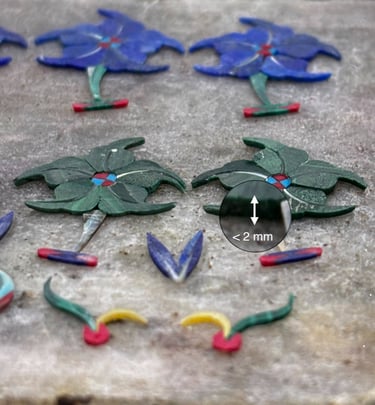
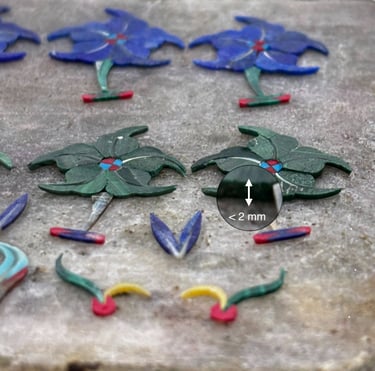
The depth and security of stone placement serve as primary indicators when determining authentic Parchin Kari versus mass produced & machine-made replicas. Genuine handmade marble inlay demonstrates consistent inlay depths ranging from 1.5 to 2 millimeters, achieved through precise hand-chiseling techniques passed down through generations of artisans. Each stone sits flush with the marble surface, creating a seamless integration that machine processes struggle to replicate.
Authentic Parchin Kari exhibits stones that appear permanently locked within their carved recesses. When examining the piece closely, the stones should show no movement or looseness when gentle pressure is applied. Traditional artisans create microscopic undercuts beneath each stone, forming mechanical locks that secure inlays for centuries. Mass produced & machine-made versions often rely solely on adhesives, resulting in stones that may shift slightly or display visible gaps around edges.
The cutting precision around stone boundaries reveals critical authentication details. Handmade marble inlay features clean, crisp edges where stones meet marble, with no visible adhesive residue or irregular spacing. Authentic pieces demonstrate consistent inlay depths across the entire design, while mass produced & machine-made replicas frequently show variations where automated tools struggle to maintain uniform cutting depths.
2.) Examining Border and Pattern Symmetry Standards
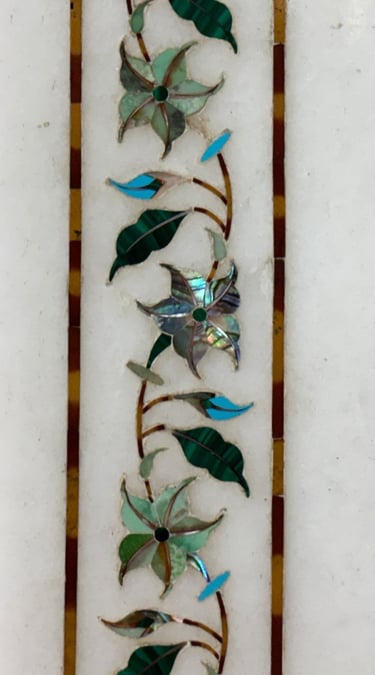
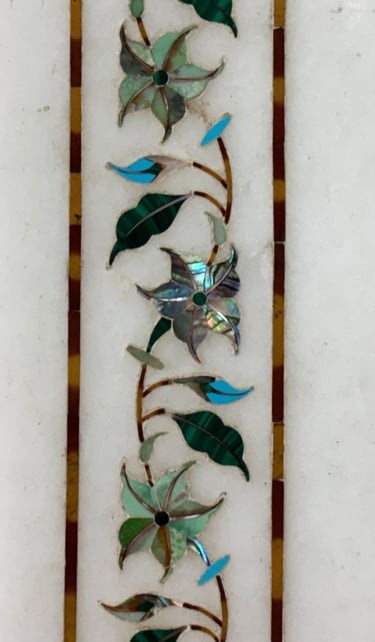
Border symmetry in genuine Parchin Kari reflects the master craftsman's skill and attention to detail. Authentic pieces display borders with mathematical precision, where repeating elements maintain consistent spacing and proportions throughout the design. Traditional artisans work from carefully planned drawings, ensuring each element aligns perfectly with the overall composition.
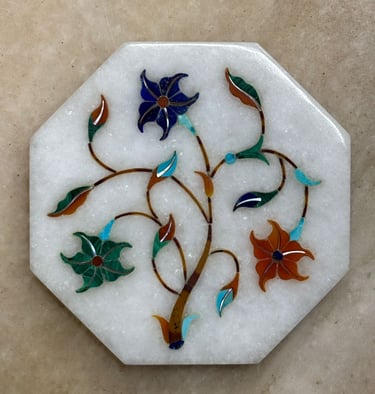
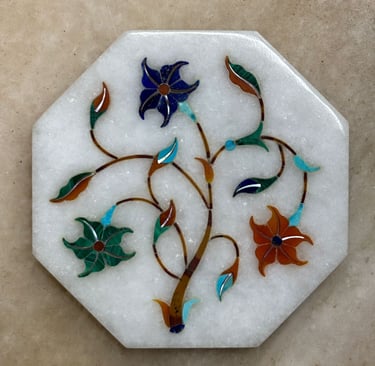
Pattern flow in handmade marble inlay demonstrates organic continuity that machine production cannot match. Authentic Parchin Kari shows subtle variations in line thickness and stone placement that create visual rhythm and movement. These micro-variations actually enhance the overall symmetry rather than detract from it, creating a harmonious balance that feels natural to the eye.
Corner treatments provide another crucial authentication marker. Genuine Parchin Kari features corners where patterns transition smoothly without abrupt interruptions or awkward adjustments. Master artisans plan corner solutions during the design phase, ensuring pattern elements resolve gracefully at intersection points. Mass produced & machine-made pieces often display forced corner solutions where automated processes struggle to adapt patterns naturally.
3.) Recognizing Artistic Flow and Design Harmony
Artistic flow in genuine Parchin Kari reflects the craftsman's understanding of proportion, balance, and visual movement. Authentic pieces demonstrate design elements that guide the eye naturally through the composition, creating focal points and visual rest areas that feel intuitive and pleasing. This artistic sensibility develops through years of training and cannot be programmed into machine production.
Design harmony emerges from the master artisan's ability to balance competing elements within the composition. Color relationships, pattern scales, and motif placement work together to create unified visual experiences. Authentic Parchin Kari shows evidence of artistic decision-making where slight adjustments to standard patterns enhance overall composition quality.
The relationship between positive and negative space reveals the craftsman's artistic sophistication. Genuine handmade marble inlay demonstrates thoughtful use of plain marble areas that provide visual breathing room and emphasize decorative elements. Mass produced & machine-made versions often lack this spatial sensitivity, resulting in compositions that feel crowded or unbalanced despite technical accuracy in pattern reproduction.
© Subhash Emporium 2026
All trademarks used are the property of their respective owners.
inlayartisan@gmail.com