How to visually check the authenticity of your Parchin Kari (marble inlay) art piece.
Discover how to identify authentic handcrafted Parchin Kari (marble inlay) art and distinguish it from machine-made imitations. From examining the precision of the inlay work and the quality of semi-precious stones to understanding the characteristics of genuine marble, this guide helps art lovers and collectors appreciate the true craftsmanship behind this centuries-old art form inspired by the exquisite beauty of the Taj Mahal. Learn the essential visual checks that reveal the authenticity, heritage, and artistry of genuine marble inlay work.
Essential Visual Inspection Techniques to Authenticate Semi-Precious Stones in Parchin Kari
Examining Stone Setting Precision and Alignment
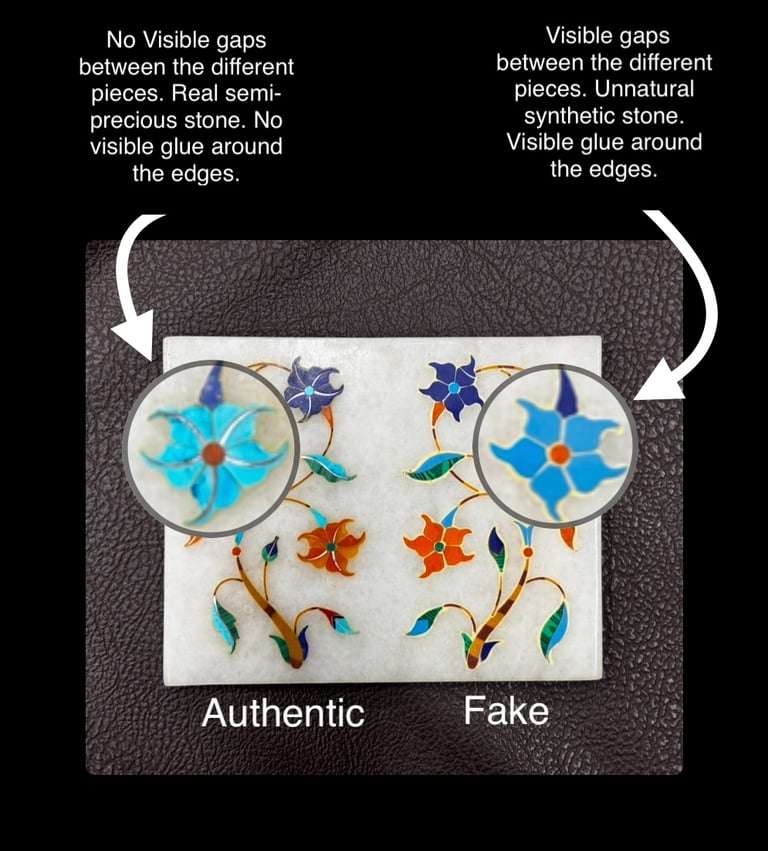
Authentic Parchin Kari reveals itself through the microscopic precision of stone placement. Master craftsmen achieve near-perfect alignment where individual stones fit together like pieces of an intricate puzzle. There shouldn't be any gaps between the inlaid stones in genuine marble inlay work, creating seamless visual flow. Mass produced & machine-made replicas typically show wider, irregular gaps or artificially uniform spacing that lacks the subtle variations of human craftsmanship.
The stone setting in traditional Parchin Kari demonstrates extraordinary attention to geometric patterns. Each stone receives careful positioning to maintain the overall design integrity, with slight adjustments made to accommodate natural variations in stone size. Authentic pieces show stones that align perfectly with the underlying pattern, while mass produced & machine-made versions often display stones that appear forced into predetermined spaces.
Examining the depth consistency of stone setting provides another authentication marker. Hand-set stones in authentic Parchin Kari maintain uniform depth levels, with each piece sitting flush with the marble surface. The setting adhesive remains invisible in genuine pieces, whereas mass produced & machine-made replicas may show excess adhesive or uneven depths where automated processes failed to account for natural stone variations.
1.) Identifying Hand-Shaped vs Machine-Cut Stone Edges
Hand-carved stone edges in authentic marble inlay art display characteristic micro-variations that distinguish them from machine-precision cuts. Traditional craftsmen use specialized tools to shape each stone individually, creating subtle irregularities along the edges that contribute to the piece's authentic character. There have only been a few master craftsmen or 'ustads' of the modern generation who achieved a machine level precision with their hands. Amongst them include, late Ustad Mohammed Zafar Hussain & Ustad Mohammed Shameem whose works exhibited in the museum of Subhash Emporium are considered the finest pieces every created in this artform.
Machine-cut stones exhibit perfectly uniform edges with smooth surfaces. While this precision might appear superior, it lacks the organic quality that defines handmade marble inlay. These edges are achieved because of using machine grinders for shaping the stones.
2.) Recognizing Natural Color Variations in Authentic Stones
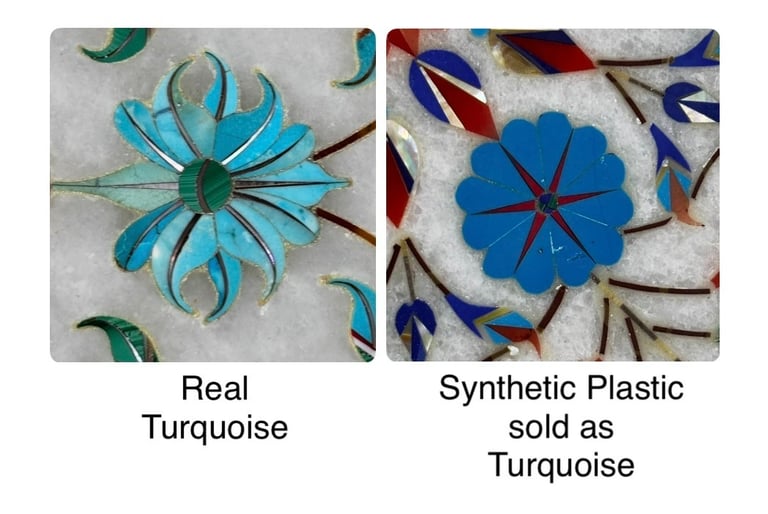
Natural precious and semi-precious stones used in genuine Parchin Kari exhibit subtle color gradations and mineral inclusions that mass produced & machine-made replicas cannot replicate convincingly. Authentic pieces incorporate stones with natural color variations within individual pieces, creating depth and visual interest. These variations appear random and organic, following the natural formation patterns of the source minerals.
Dyed or synthetic stones in mass produced & machine-made replicas display uniform coloration throughout each piece. The colors often appear artificially vibrant and lack the subtle tonal shifts found in natural materials. Authentic Parchin Kari uses stones where color intensity varies slightly across the surface, creating natural highlights and shadows.
A very easy way to identify fake or synthetic stones in marble inlay art is by poking them with a needle. If the stone gets pierced easily or with slightest of pressure, then the stone is fake or synthetic. The needle will always tend to slip on a real hard semi-precious stone indicating its authenticity.
The aging characteristics of natural stones provide additional authentication clues. Genuine stones develop patina over time, with colors becoming more mellow and integrated. Mass produced & machine-made pieces using synthetic materials maintain their original brightness and fail to develop the characteristic aging patterns seen in authentic marble inlay craftsmanship quality.
3.) Spotting Inconsistencies That Indicate Human Craftsmanship
Paradoxically, slight imperfections serve as markers of authenticity in handmade Parchin Kari identification. Master craftsmen working by hand produce variations in line thickness, pattern symmetry, and stone placement that reflect the human element in creation. These inconsistencies, typically measuring less than 1 millimeter by a master craftsmen and 3-5 millimeter by an apprentice artist, add character and confirm hand-crafted origins.
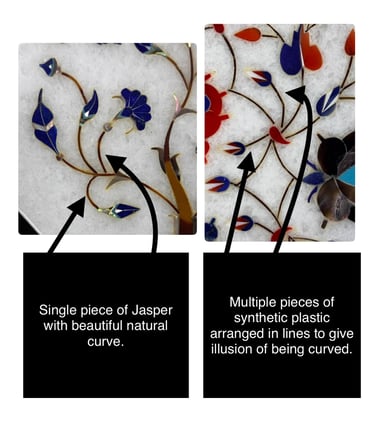
Pattern flow in authentic pieces shows organic transitions where designs adapt to the natural constraints of working with individual stones. Even after being separate pieces of different sizes, an authentic workshop shapes these pieces in a beautifully flowing (natural) curving shapes. Mass produced & machine-made replicas maintain rigid pattern adherence with pieces that are straight rather than being curved without the subtle adjustments that craftsmen make to enhance overall visual harmony. These human decisions create unique characteristics that distinguish each authentic piece. A rose design is the most common motif in poorly crafted or mass produced pieces.
The surface texture of genuine Parchin Kari displays minute variations in polish levels and stone heights. Hand-polishing creates slight undulations that affect light reflection across the surface. Mass produced & machine-made versions typically show perfectly uniform surface levels that lack this dynamic quality, resulting in static light reflection patterns that appear artificial compared to authentic marble inlay art.